

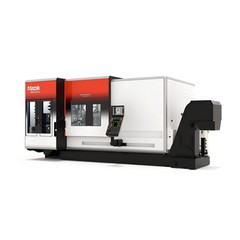
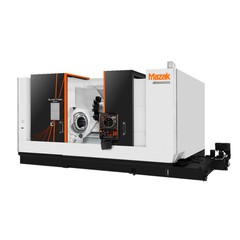
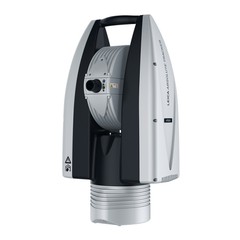
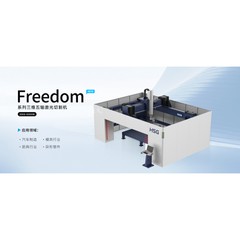
As a core piece of equipment in modern CNC machining, machining centers demonstrate significant advantages in manufacturing due to their high integration, automation, and flexibility.Their advantages are not only reflected in improved machining efficiency and precision, but also in their ability to integrate complex processes and optimize production models, providing solid support for high-quality, multi-variety manufacturing demands.
The primary advantage lies in the concentration of processes and the ability to complete multiple tasks in a single setup. In traditional machining methods, milling, drilling, boring, and tapping processes often need to be completed separately on different machine tools, involving multiple setups and positioning, which easily leads to cumulative errors. Machining centers, by integrating multiple cutting functions and automatic tool changers, can continuously complete multiple processes in a single setup, reducing auxiliary time and setup errors while ensuring the positional accuracy between various features of the part, significantly improving machining consistency and quality stability.
Secondly, there is the efficiency improvement brought about by high automation. The machining center is equipped with a tool magazine and automatic tool changer (ATC), enabling automatic tool changing during machining without manual intervention. Combined with pallet exchange or multi-table systems, it allows for unattended continuous production overnight, significantly improving equipment utilization and production cycle time. In mass production, this automation advantage shortens manufacturing cycles, reduces labor costs, and minimizes quality fluctuations caused by manual operations.
Multi-axis linkage and complex surface machining capabilities are its technological highlights. Modern machining centers generally possess three or more axes of linkage, especially five-axis machining centers. Through the coordinated movement of two rotary axes and three linear axes, high-precision machining of complex free-form surfaces can be completed in a single setup, avoiding form and position errors caused by multiple setups. This meets the stringent surface quality requirements of fields such as aerospace impellers, mold cavities, and medical implants. This capability makes machining centers irreplaceable equipment in high-end manufacturing.
Precision and stability advantages are equally prominent. The machining center employs a high-rigidity machine tool structure, precision guideways, and ball screw or linear motor drives. Combined with a fully closed-loop or semi-closed-loop position feedback system, it can achieve micron-level or even sub-micron-level positioning and repeatability accuracy. The application of constant-temperature cooling, spindle thermal deformation compensation, and vibration suppression technologies further ensures dimensional stability during long-term continuous machining, providing reliable assurance for precision parts manufacturing.
Its flexible production capabilities allow it to adapt to the needs of multi-variety, small-batch production. Through rapid switching of CNC programs and modular configuration of tools and fixtures, the machining center can complete changesovers for different parts in a short time without large-scale adjustments to the equipment structure, significantly reducing changeover costs and cycles. This feature aligns with the trend of modern manufacturing towards personalization and customization, enhancing the company's responsiveness to market changes.
Furthermore, the machining center excels in integrated auxiliary functions. The integrated design of cooling and lubrication, chip removal, and hydraulic and pneumatic control systems not only optimizes the machining environment but also reduces the need for external equipment. The introduction of intelligent monitoring and diagnostic systems can collect data on vibration, temperature, and load in real time, enabling tool wear prediction and fault warning, further improving operational reliability and maintenance efficiency.
Overall, machining centers offer advantages in many aspects, including process concentration, high automation and efficiency, complex multi-axis machining, high precision and stability, flexible production, and intelligent integration. These advantages make them key equipment for modern manufacturing industries to enhance processing capabilities, ensure product quality, and achieve intelligent manufacturing, playing a central role in promoting industrial upgrading and technological innovation.