

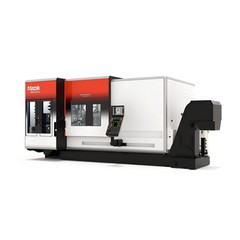
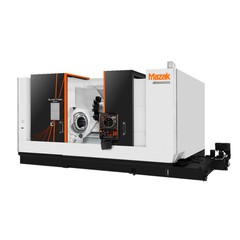
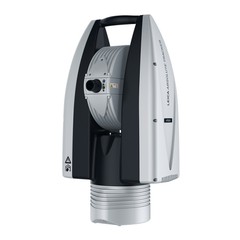
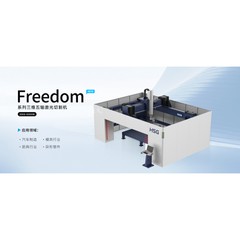
The reason machining centers can undertake the efficient and precise machining of complex parts in modern manufacturing lies in their complete functional foundation, which is based on CNC technology and integrates mechanical structure, drive control, automatic tool change, and auxiliary systems.This foundation not only supports the realization of multi-process integration and highly automated operations but also provides stable and reliable technical support for the machining of complex geometries.
The core functional foundation of machining centers is primarily the instruction parsing and multi-axis collaborative control of the CNC system. This system reads the machining program, converts the geometric path and process parameters into motion commands for each coordinate axis, and generates smooth and continuous trajectories based on interpolation algorithms. Multi-axis linkage capability allows the X, Y, and Z linear axes and A, B, and C rotary axes to move synchronously according to predetermined relationships, thereby completing complex actions such as planar milling, contour machining, spatial surface engraving, and multi-faceted positioning. Full or semi-closed-loop position feedback ensures that the actual displacement is highly consistent with the command, laying the foundation for high-precision machining.
The rigid structure and precision transmission of the machine tool body are the physical support for the realization of these functions. The high-rigidity bed and column are constructed of high-quality cast iron or welded steel and undergo aging treatment to suppress deformation and vibration under high-speed cutting and heavy loads. Precision guideways and rolling or sliding pairs are pre-loaded and lubricated to ensure low friction and high positioning accuracy of the moving parts. Feed drives commonly use ball screws or linear motors; the former is mature and reliable, while the latter offers superior speed and acceleration performance to meet high-speed machining requirements. The spindle unit achieves stepless speed regulation and constant power output through frequency converters or servo drives, adapting to different materials and cutting conditions.
The automatic tool changer (ATC) and tool magazine system constitute key components for centralized and continuous machining. Tool magazines, based on capacity and structure, can be categorized into cap-type, disc-type, and chain-type, automatically selecting and changing tools according to the program during machining, significantly reducing non-cutting time and manual intervention. A tool-changing robot or cam mechanism ensures rapid action and accurate positioning, while standardized tool holders and pull studs ensure compatibility and reliability. This functional foundation enables the machining center to complete multiple operations such as milling, drilling, boring, and tapping in a single setup. The coordinated operation of auxiliary systems expands the machining center's process adaptability and stability. The cooling and lubrication system reduces tool and workpiece temperature and friction through cutting fluid or micro-lubrication, extending tool life and improving surface quality. Chip removal devices promptly remove chips, preventing secondary scratches and blockages in the machining area. Hydraulic and pneumatic systems power clamping devices, tool changers, and protective doors, ensuring rapid and precise operation. Temperature control and protection designs further suppress thermal deformation and the intrusion of dust and oil, maintaining the long-term accuracy and reliability of the equipment.
Detection and feedback devices provide real-time status awareness and closed-loop correction capabilities for the functional foundation. High-precision position detection elements such as linear scales, encoders, and rotary transformers form a position closed loop, ensuring trajectory accuracy. Temperature, vibration, and load sensors monitor the operating health of the spindle and feed system, providing data support for preventative maintenance and intelligent diagnostics.
In summary, the functional foundation of a machining center consists of CNC multi-axis control, a high-rigidity precision mechanical structure, an automatic tool changer and tool magazine system, collaborative auxiliary systems, and real-time detection and feedback devices. These elements are interdependent and organically integrated, enabling the equipment to possess core capabilities such as process concentration, multi-task completion in a single clamping, complex surface machining, and high automation, thus becoming the technological cornerstone for modern manufacturing to achieve efficient, precise, and flexible production.