

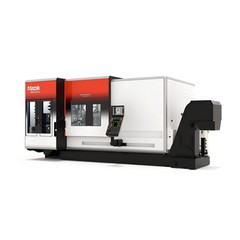
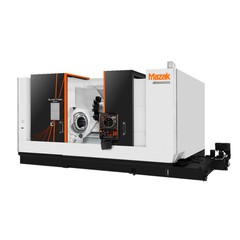
As the manufacturing industry accelerates towards precision and efficiency, turning centers, with their unique functional integration and technological advantages, have become a practical core piece of equipment for enterprises to improve production efficiency and reduce overall costs. Their practicality is not only reflected in the efficiency breakthroughs of single processes, but also in their ability to adapt to the entire process of complex manufacturing scenarios, providing feasible solutions for production entities of different sizes and application fields.
From the perspective of production process optimization, the practicality of turning centers is first manifested in the qualitative change in efficiency brought about by "process integration." In traditional machining modes, rotating parts need to be transferred through multiple machines such as lathes, milling machines, and drilling machines. Multiple clamping not only prolongs the cycle time but also easily affects accuracy due to the accumulation of positioning errors. Turning centers, by integrating functions such as turning, milling, drilling, and tapping, enable multi-process machining to be completed in a single clamping, shortening the manufacturing cycle of typical parts by 30% to 50%, while reducing equipment space and the number of operators, significantly reducing workshop layout and labor costs. This "one-for-many" capability is particularly advantageous for small-batch, multi-variety production scenarios, effectively alleviating the pain point of low changeover efficiency in traditional production lines.
In terms of precision and quality stability, the practicality of turning centers is equally outstanding. Equipped with a multi-axis linkage control system and intelligent compensation technology, it can correct interference factors such as tool wear and thermal deformation in real time, ensuring micron-level machining accuracy. This is especially suitable for fields with stringent dimensional consistency requirements, such as automotive parts and hydraulic components. In actual production, this feature can increase the part yield rate to over 98%, reducing rework and material waste, and directly lowering overall manufacturing costs.
Faced with the challenges of machining complex parts, the practicality of turning centers is further reflected in their "flexible adaptability." Whether it's machining the irregular curved surfaces of motor shafts in new energy vehicles or handling the difficult-to-cut titanium alloy parts in the aerospace field, its power turret, C-axis indexing, and high-rigidity structural design can flexibly address the needs of multi-process collaboration, overcoming the limitations of traditional equipment in machining complex features. Furthermore, some models support quick tool changes and program recall, allowing seamless switching between machining tasks for different parts, aligning with the trends of personalized customization and small-batch production.
In summary, turning centers, with their practical value of "high efficiency, precision, and flexibility," have become key tools for the manufacturing industry to meet diverse needs and enhance competitiveness. Their widespread application will continue to unleash production potential and drive the industry towards higher quality levels.