

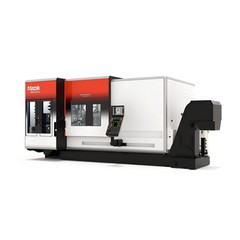
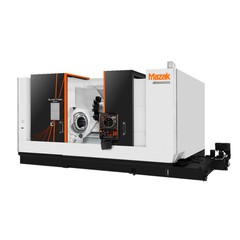
In the field of modern machining, turning centers, as composite CNC equipment integrating multiple processes and high precision, have become a key force driving the transformation of the manufacturing industry towards intelligence and efficiency.By integrating functions such as turning, milling, drilling, and tapping, they break through the limitations of traditional lathes' single-processing capabilities, demonstrating significant advantages in the manufacture of complex parts.
From a technical perspective, the core competitiveness of turning centers lies in their "composite" and "intelligent" nature. Equipped with a multi-axis linkage control system, these machines can complete the machining of the outer diameter, end face, curved surface, and axial hole system of rotating parts in a single setup, significantly reducing process turnover errors and improving dimensional consistency. Some high-end models further incorporate a powered turret and C-axis indexing function, achieving combined turning and milling cutting, streamlining processes that previously required multiple machines, and significantly reducing production cycles and manual intervention costs. Simultaneously, relying on real-time data acquisition and adaptive control technology, turning centers can dynamically compensate for factors such as tool wear and thermal deformation, ensuring micron-level machining accuracy and meeting the stringent tolerance requirements of aerospace, automotive precision components, and other fields. In industrial applications, the value of turning centers lies not only in efficiency improvements but also in supporting the "one-stop" manufacturing of complex parts. For example, irregularly shaped rotating parts such as motor shafts for new energy vehicles and hydraulic valve cores, with features like deep holes, eccentric grooves, and spiral oil passages, require multi-process collaboration. Traditional machining methods are prone to cumulative errors due to multiple clamping operations. However, turning centers, through process integration and intelligent programming, can increase the yield rate of such parts to over 98% while shortening the production process by 30%-50%. This characteristic has led to a continuous increase in their penetration rate in high-end equipment and energy equipment sectors.
Currently, with the deepening of Industry 4.0 and intelligent manufacturing, turning centers are evolving towards greater intelligence and flexibility. The integration of AI algorithms enables them to self-optimize process parameters, while digital twin technology supports virtual debugging and remote operation and maintenance, further lowering the barrier to entry. As the "mother machine" of precision manufacturing, the upgrading and iteration of turning centers will continue to empower the industrial chain to improve quality and efficiency, becoming a crucial cornerstone of the manufacturing industry's core competitiveness.