

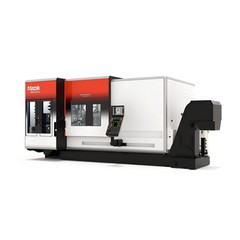
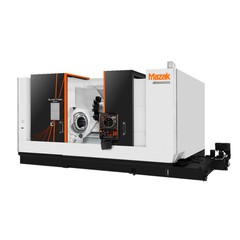
In the context of contemporary manufacturing's development towards high precision, high efficiency, and high flexibility, turning centers, as composite CNC equipment integrating turning, milling, drilling, and tapping processes, are increasingly important and have become a key node supporting modern industrial production systems. They are not only a technological carrier for improving processing capabilities but also a strategic resource for driving industrial upgrading and enhancing enterprise competitiveness.
The primary importance of turning centers lies in the unification of process integration and machining accuracy. In traditional machining methods, rotating bodies and related complex parts often need to be completed step-by-step on multiple machines. Multiple clamping inevitably leads to the accumulation of positioning errors, affecting dimensional consistency and geometric accuracy. Turning centers can complete multiple processes in a single clamping, shortening the process flow and significantly reducing accumulated errors, enabling the stable achievement of micron-level or even higher precision requirements. This is irreplaceable for fields such as aerospace, automotive, and energy, where the precision of parts is extremely demanding.
Turning centers are equally significant in terms of production efficiency and economy. Its multi-axis linkage and powered turret configuration streamline previously dispersed turning, milling, and drilling processes, reducing the number of equipment, production area, and personnel required, while shortening production cycles and accelerating product delivery. For multi-variety, small-batch production models, turning centers can quickly switch programs and tools, achieving flexible manufacturing and helping companies respond flexibly to changes in market demand, reducing inventory and capital tied up.
Turning centers also bear the important mission of promoting intelligent manufacturing. Modern turning centers are generally equipped with real-time data acquisition, online monitoring, and adaptive control functions, enabling interconnection with upper-level information systems to achieve process parameter optimization, remote diagnostics, and predictive maintenance. This integration of digitalization and intelligence not only improves the reliability of equipment operation but also lays the foundation for building a transparent and traceable production system, making the manufacturing process more controllable, adjustable, and sustainable.
More profoundly, as the "mother machine" of high-end equipment, the technological level of turning centers directly affects a country or region's comprehensive strength in the field of precision manufacturing. Its research and development and application level are related to the independent controllability of key basic components and the security and resilience of the industrial chain. Therefore, prioritizing and continuously improving the design, manufacturing, and application capabilities of turning centers is an essential path for the manufacturing industry to move towards the high end of the global value chain.
In conclusion, turning centers are of core importance in ensuring precision, improving efficiency, and promoting flexible and intelligent manufacturing. They are indispensable cornerstone equipment in modern manufacturing, and their strategic position will be further consolidated as industrial upgrading deepens.