

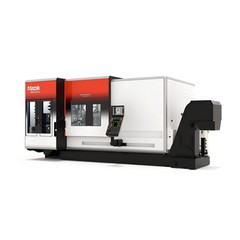
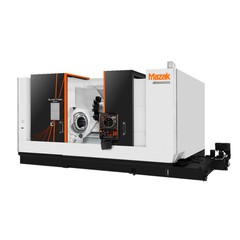
As a key piece of equipment in modern CNC machining systems, turning centers have expanded beyond the boundaries of traditional lathes, widely penetrating various industries and machining scenarios for different types of parts, becoming core equipment supporting the diversified needs of the manufacturing industry.Their characteristics of "composite, high precision, and high efficiency" make them crucial in the manufacturing of everything from general-purpose parts to high-end precision components.
In the field of general machinery manufacturing, turning centers primarily serve the efficient machining of conventional rotating parts. For example, the machining of the outer diameter, end faces, threads, and simple hole systems of various shafts, discs, and sleeves, which traditionally requires multiple steps using lathes, drilling machines, and other equipment, can be completed by turning centers in a single setup, significantly improving the stability and efficiency of mass production. These application scenarios demand high cost-effectiveness and ease of operation from the equipment, representing the most widespread basic market for turning centers.
In the automotive and parts industry, the application scope of turning centers extends towards greater complexity. Engine crankshafts, camshafts, and gearbox gear blanks often involve eccentric structures, helical oil passages, and multi-step structures, requiring collaborative machining processes including turning, milling, and drilling. The power turret and C-axis indexing function of turning centers can precisely achieve these complex machining operations, meeting the automotive industry's dual demands for part consistency and lightweighting. Furthermore, the precision machining of key components such as drive motor shafts and reducer housings in new energy vehicles also relies on the high precision and multi-process integration capabilities of turning centers.
The high-end equipment manufacturing sector further expands the application boundaries of turning centers. Parts in the aerospace field, such as turbine disks and landing gear actuators, are often made of difficult-to-machine materials such as titanium alloys and high-temperature alloys, and have stringent requirements for dimensional accuracy and surface quality. Turning centers, with their high-rigidity structures, intelligent thermal compensation technology, and ultra-precision spindle systems, can achieve stable cutting in such scenarios, ensuring the reliability of part performance. In the energy industry, the deep hole machining and precision forming of large rotating parts such as wind turbine main shafts and nuclear power valve seals also require the large stroke and high torque characteristics of turning centers.
Currently, with the advancement of intelligent manufacturing, the application scope of turning centers is expanding to flexible production of small batches and multiple varieties. Their cross-industry adaptability continues to improve, making them a core tool for the manufacturing industry to meet diversified needs.