

Machining centers, as CNC equipment integrating multiple processes such as milling, drilling, boring, and tapping, can be classified into various types due to differences in their structural forms, motion axis configurations, and functional characteristics, to meet the diverse needs of different industries and machining objects. A systematic understanding of these types helps in making reasonable selections based on workpiece characteristics and process requirements in production practice, thereby improving machining efficiency and quality stability.
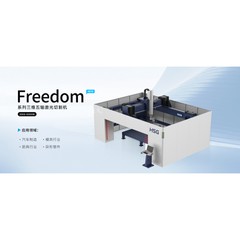
From a structural layout perspective, machining centers can be primarily divided into three basic categories: vertical, horizontal, and gantry. Vertical machining centers have their spindle axis perpendicular to the worktable surface, resulting in a compact structure, small footprint, and easy workpiece observation and clamping. They are suitable for planar milling, drilling, and contour machining of sheet metal, discs, and small to medium-sized box-shaped parts. Their tool changing mechanism is usually located on the side or top of the column for quick tool changes, but multi-face machining requires re-clamping or the use of a rotary fixture. Horizontal machining centers have their spindle axis parallel to the worktable surface. The worktable often features a rotary indexing function, allowing for multi-faceted machining in a single setup. They are particularly suitable for long, narrow, shell-like parts and parts requiring multiple machining operations, and are widely used in the manufacture of automotive engine blocks and gearbox housings. Gantry machining centers, with a gantry frame as their main body and a crossbeam spanning both sides of the worktable, possess high rigidity, large stroke, and good torsional resistance. They are suitable for machining large structural parts, molds, thin-walled aerospace parts, and ultra-long, ultra-heavy workpieces such as the roots of wind turbine blades. Their spindles can be vertical or horizontal, offering strong process adaptability.
Based on the number of motion axes and their linkage capability, machining centers can be divided into three-axis, four-axis, and five-axis types. Three-axis machining centers have three linear axes (X, Y, and Z), capable of general contour and planar machining. They have a simple structure, relatively moderate cost, and the widest range of applications. Four-axis machining centers add a rotary axis to the three-axis system, which can be achieved by table rotation (A-axis or B-axis) or spindle head oscillation. They are suitable for machining parts with cylindrical surfaces, blades, and other features, reducing the number of setups and improving geometric accuracy. Five-axis machining centers simultaneously feature two rotary axes and three linear axes, enabling high-precision machining of complex free-form surfaces in a single setup. This avoids multiple positioning errors and is widely used in fields with extremely high surface quality requirements, such as aerospace impellers, mold cavities, and medical implants. Five-axis machine tools can be further subdivided structurally into various types, including those with dual-rotary table, dual-rotary spindle head, and hybrid types, each with its own advantages and disadvantages. The choice must be made based on the workpiece size and machining range.
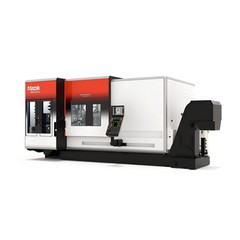
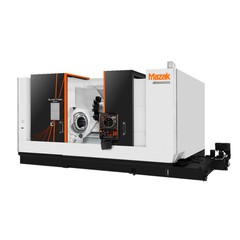
Extending from function and application, we can also see special types such as drilling and tapping centers and mill-turning centers. Drilling and tapping centers primarily function for high-speed drilling and tapping, with high spindle speeds and fast tool change rates, making them suitable for batch precision hole machining of 3C product housings, small hardware parts, and other similar products. Milling-turning machining centers integrate CNC lathe and milling functions, enabling multiple processes such as turning, milling, and drilling to be completed on the same machine. They are particularly suitable for the "one-step forming" of complex shaft and disc-shaped parts, reducing process turnaround and clamping errors.
Furthermore, based on automation level and scale, machining centers can be categorized into general-purpose machining centers and machining centers within Flexible Manufacturing Cells (FMC) and Flexible Manufacturing Systems (FMS). The latter are equipped with automatic pallet exchange, robotic loading and unloading, and a central tool magazine sharing system, enabling continuous automated production of multiple varieties and small to medium batches, meeting the intelligent and high-efficiency requirements of modern discrete manufacturing.
In general, the classification of machining centers reflects a multi-faceted integration of structure, axis configuration, function, and automation level. Different types have unique characteristics in rigidity, stroke, accuracy, ability to machine complex curved surfaces, and applicable workpiece range. When selecting a machining center, the geometric characteristics of the part, material properties, production volume, and process route should be comprehensively considered to form the optimal machining solution based on the advantages of each type, thereby fully leveraging the core value of machining centers in improving manufacturing accuracy and efficiency.