

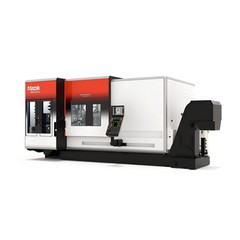
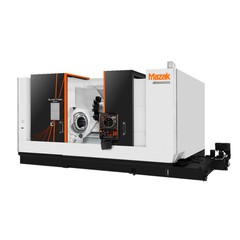
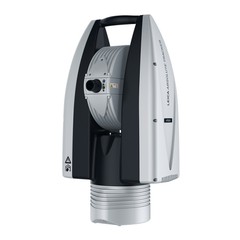
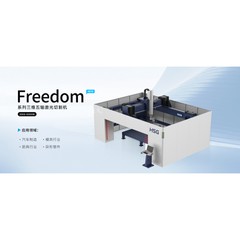
As core equipment for achieving high-precision material removal and forming, the overall performance and service life of a machining machine largely depend on the main structural materials used. Materials not only determine the machine tool's static and dynamic rigidity, thermal stability, and vibration resistance, but also directly affect the maintenance of machining accuracy and long-term reliability. Therefore, the selection and performance matching of materials for key components of the machining machine constitute important technical issues in the design and manufacturing process.
Basic load-bearing components such as the bed, column, and crossbeam are typically made of high-strength cast iron or granite. Gray cast iron, due to its excellent damping characteristics and casting machinability, can effectively absorb vibrations during the cutting process, improving machining stability; its internal flake graphite structure can buffer impact loads and delay fatigue crack propagation. Some high-precision models use Meehanite cast iron or ductile iron, with further improvements in strength and wear resistance through alloy composition and heat treatment optimization. Granite, due to its extremely low coefficient of thermal expansion and excellent dimensional stability, is used in ultra-precision machining centers or coordinate measuring equipment that is highly sensitive to temperature drift, maintaining micron-level geometric accuracy outside of constant-temperature environments.
Guideways and slides are mostly made of high-quality alloy steel with surface hardening treatment. Commonly used materials include carburized and quenched steel or nitrided steel. These materials combine high surface hardness with core toughness, resisting wear and plastic deformation of the guideway surface and ensuring the straightness and contact rigidity of the moving parts during long-term use. For high-speed, light-load models, aluminum alloys and composite materials are also used to reduce moving mass, but reinforcement ribs and high-rigidity support structures are needed to compensate for insufficient rigidity.
The requirements for materials in the spindle assembly are particularly stringent, often using high-strength alloy steel or special steel grades. The spindle core is mostly made of chromium-molybdenum alloy steel or carburized steel, tempered and surface high-frequency quenched to obtain high fatigue strength and wear resistance. To adapt to the centrifugal force and thermal load during high-speed rotation, some high-end spindles use high-strength stainless steel or titanium alloy to reduce mass and improve corrosion resistance. Bearing housings and sleeves are made of inoculated cast iron or preloaded steel sleeves to ensure bearing assembly accuracy and support rigidity.
Transmission components such as lead screws, racks, and gears are generally made of chromium-molybdenum alloy steel or carburized steel, and undergo precision grinding and surface hardening to ensure transmission accuracy and wear life. Ball screws, due to their need to withstand repeated loads and high-speed motion, require materials with good dimensional stability and fatigue resistance to prevent backlash and increased reverse backlash.
With the trend towards lightweighting and composite structures, carbon fiber reinforced composite materials and honeycomb sandwich structures are beginning to be used in non-load-bearing components such as guards and worktables. This can significantly reduce the mass of moving parts and improve dynamic response, but the issues of thermal expansion matching with the metal frame and connection reliability need to be addressed.
Overall, the selection of main materials for machining centers focuses on rigidity, damping, wear resistance, thermal stability, and process adaptability. Different components are configured differently based on their stress characteristics and working conditions. A scientifically matched material system not only provides a solid mechanical foundation for machine tools, but also ensures that they can continuously output high-precision and high-reliability machining capabilities under complex working conditions, supporting the modern manufacturing industry's continuous pursuit of quality and efficiency.